July 2025: Statistical models are data hungry and the scientific literature is dominated by widespread, common or abundant species that are relatively easy to analyse.
Fire ecologists (myself included) often exclude rare species from their data because sparse data are difficult to analyse. This poses a huge risk of biasing our understanding of the impacts of fire. Rare species are rare for a reason and might have different fire responses than common species. This problem plagued me for more than a decade and motivated me to re-visit an old dataset from my PhD, in collaboration with my masters student Amber Lim.
Our recently published paper, suggests that the effects of wildfire on rare reptile species are harder to detect than those of common, dominant species which are often favored by disturbance (and scientific research).
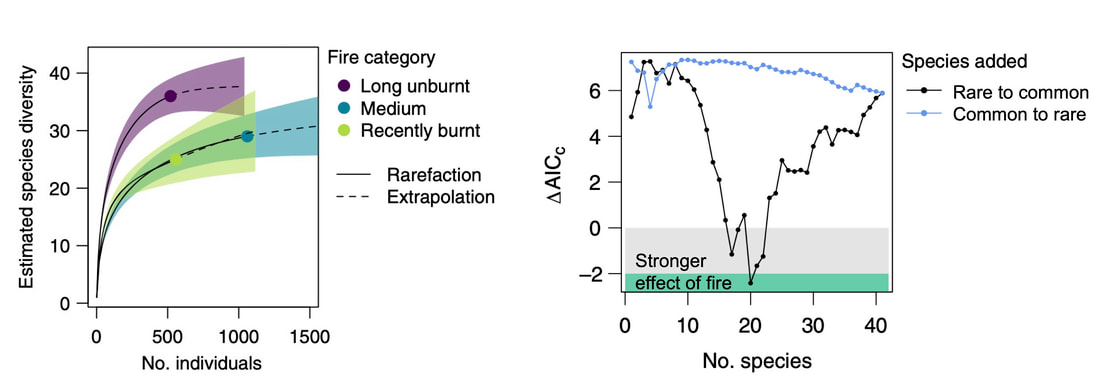
When accounting for incomplete sampling, unburnt habitat was more diverse, accumulated species more quickly, and required a greater sampling effort to obtain sample coverage comparable to habitat burned by wildfire. Fire effects were more evident when rare species were added to the dataset before common ones.
Fires in this study region were mostly high-intensity wildfires. Indigenous burning regimes that result in smaller and more patchy fires are more likely to conserve rare and cryptic reptile species.
Fire ecologists (myself included) often exclude rare species from their data because sparse data are difficult to analyse. This poses a huge risk of biasing our understanding of the impacts of fire. Rare species are rare for a reason and might have different fire responses than common species. This problem plagued me for more than a decade and motivated me to re-visit an old dataset from my PhD, in collaboration with my masters student Amber Lim.
Our recently published paper, suggests that the effects of wildfire on rare reptile species are harder to detect than those of common, dominant species which are often favored by disturbance (and scientific research).
When accounting for incomplete sampling, unburnt habitat was more diverse, accumulated species more quickly, and required a greater sampling effort to obtain sample coverage comparable to habitat burned by wildfire. Fire effects were more evident when rare species were added to the dataset before common ones.
Fires in this study region were mostly high-intensity wildfires. Indigenous burning regimes that result in smaller and more patchy fires are more likely to conserve rare and cryptic reptile species.
Smith AL, Lim ASY (2025). Hidden influence of fire on locally rare and cryptic reptile species. Ecology 106, e70121.