| Smith Ecology Lab |
|
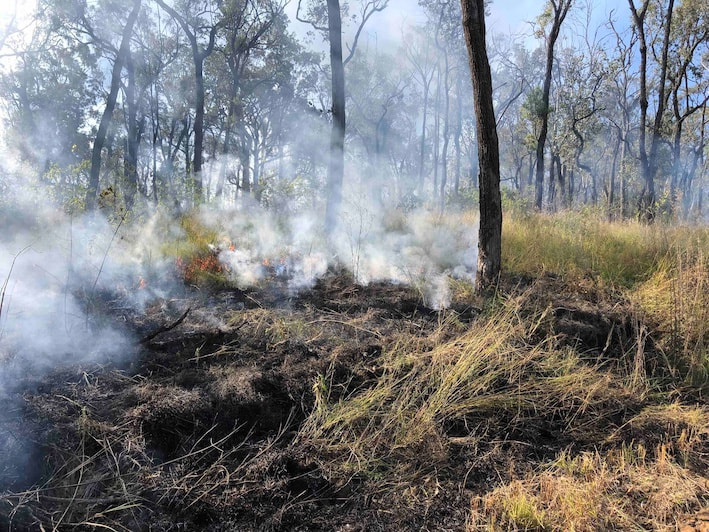
Currently, a lot of the Smith Lab's research revolves around the Hidden Vale Fire Experiment, one of the long term projects being run at Hidden Vale Research Station.
Established in 2023 by Annabel Smith, Shane Campbell (UQ School of Agriculture) and Danyel Wolff (Turner Family Foundation), the project aims to provide evidence-based fire management for subtropical grassy woodlands.
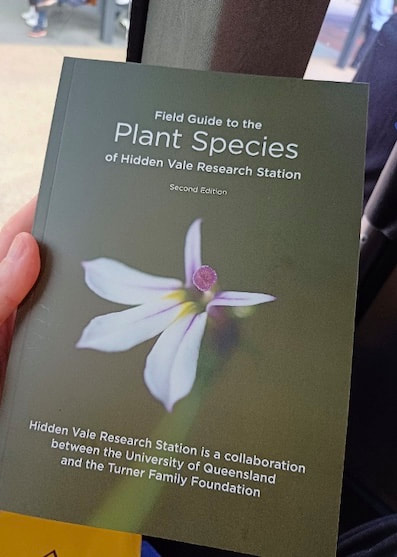
Now in its fourth year, the Experiment has delivered the first multi-year data set on plant biodiversity at Hidden Vale (183 species from over 6000 individual plant observations), treated approximately 200 ha with low-intensity prescribed fire and produced the very first Field Guide to the Plant Species of Hidden Vale.
We are doing landscape-scale fire management in an experimental way, which has only been possible through two-way sharing of complementary skills and expertise between researchers and practitioners. The replicated, controlled nature of this experiment means that it can be used to investigate the influence of fire frequency on a number of ecological parameters. If you would like to collaborate, please get in touch!
Established in 2023 by Annabel Smith, Shane Campbell (UQ School of Agriculture) and Danyel Wolff (Turner Family Foundation), the project aims to provide evidence-based fire management for subtropical grassy woodlands.
Now in its fourth year, the Experiment has delivered the first multi-year data set on plant biodiversity at Hidden Vale (183 species from over 6000 individual plant observations), treated approximately 200 ha with low-intensity prescribed fire and produced the very first Field Guide to the Plant Species of Hidden Vale.
We are doing landscape-scale fire management in an experimental way, which has only been possible through two-way sharing of complementary skills and expertise between researchers and practitioners. The replicated, controlled nature of this experiment means that it can be used to investigate the influence of fire frequency on a number of ecological parameters. If you would like to collaborate, please get in touch!
|
Managing interactions between fire regimes and invasive plants
A long history of fire has shaped many ecosystems globally, but thousands of species are now threatened with extinction because of climate change, inappropriate fire management and invasive plants. Effective fire management is more complex than simply re-instating a historical fire regime because ecosystems might require a specific initial management regime (e.g. more frequent burning) to re-establish native plant communities and increase their resilience to future invasion. We are evaluating how variation in fire frequency affects the composition and function of native and non-native plant communities. Key questions include:
The design consists of 31 sites (100 m transects each with 5 sampling points) in grassy woodlands where narrow-leaved ironbark (Eucalyptus crebra) and silver-leaved ironbark (E. melanophloia) surround gullies containing fire-sensitive Endangered Semi-evergreen vine thicket. |
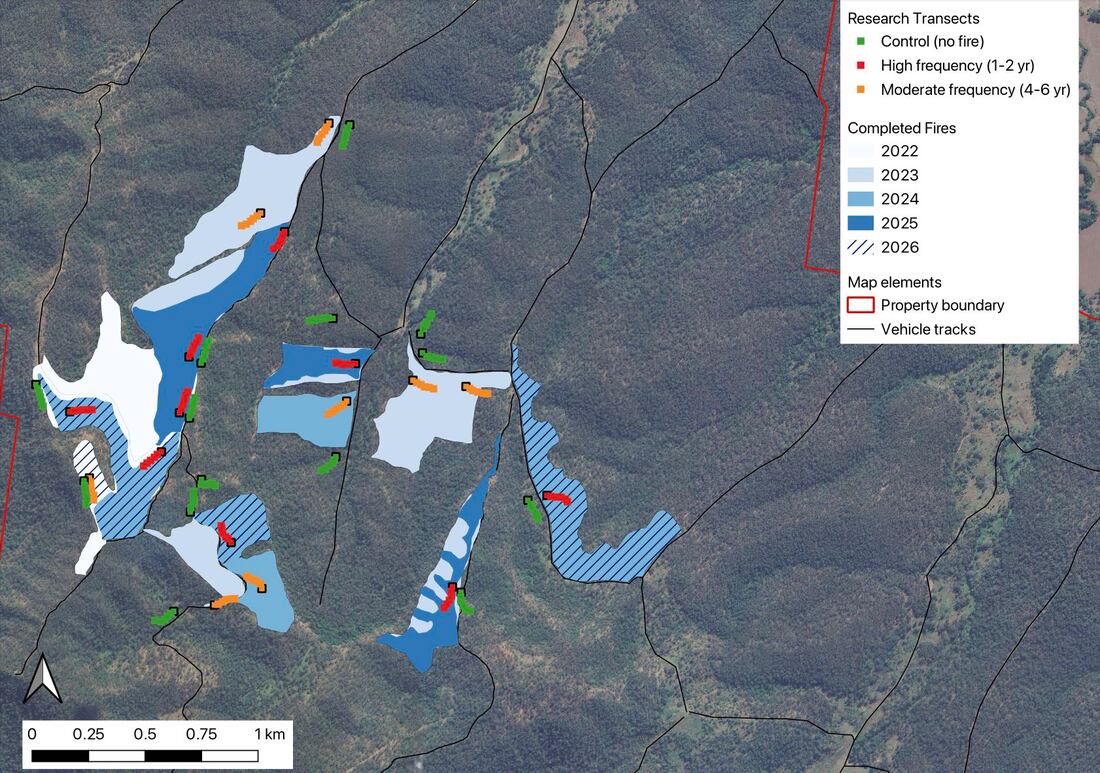
Sites are paired, each with one control (no fire) and one treatment: moderate frequency burning (4–6 years) or high frequency burning (1–2 years)
|
|
Many people have contributed to this research!
Leadership: Dr Annabel Smith, A/Prof. Shane Campbell, Danyel Wolff Research Assistants: Dr Gabrielle Lebbink, Louise McFarline, Michael Tervo, Mitchell Snow and Dr Felicity Charles Research students: Karishma Menon, Joan Zwar, Caitlin Gaskell, Natalie Dale, Ella Speedie, David Soulema and Brooke Allison, Nicola Rzepka Support: Professor Robbie Wilson, Professor Diana Fisher, Dr Julia Hoy, Dr Dalene Adam, Matt Turner, Tim Dunsdon, Max Radvan, Sam Morison TFF Fire & weeds team: Annette Nemeth, Jared Wolff and Brandon Turner Field assistance: Francoise Broderick, Charlotte Rayner, Harry Cooper, Tanya Jobling and Anna Jourdant |
Fire Experiment Publications
Gaskell C, Campbell SD, Wolff D, Lebbink G, Smith AL (2026). Diverse soil seedbanks are resilient to reintroducing low-intensity fire in a subtropical grassy woodland. Journal of Applied Ecology 63, e70409.
Gaskell C, Campbell SD, Wolff D, Lebbink G, Smith AL (2026). Diverse soil seedbanks are resilient to reintroducing low-intensity fire in a subtropical grassy woodland. Journal of Applied Ecology 63, e70409.